
 ES
ESInvesting in Punta Cana Real Estate: The Numbers You Should Check Before You Buy
 by Wiso
A strong national backdrop is not a property analysis. Foreign investment and tourism revenue can explain why Punta Cana attracts buyers. They cannot tell you whether the apartment, house, or lot in front of you is a sound purchase. The useful habit is to separate the destination story from a short list of numbers that belong to the asset.
This is a framework, not a forecast. It does not promise rental income, occupancy, or appreciation. Two buyers can look at the same building and reach different answers because their hold period, currency, and use of the home are different.
Start with the price you are actually paying
Write down the contract price, what is included, and what is still to be built or furnished. In a resort market, the headline price often mixes the unit, furniture, a rental program, and closing costs. Separate them. A lower price in a later phase is not automatically a better buy if the delivery date, the view, or the association budget is weaker.
Then place that price in a real set of alternatives. Look at more than one building, and more than one part of the east coast. Current listings are a starting inventory, not a valuation. Ask what has sold, not only what is advertised. If the only comparison is the developer’s price list, you do not yet have a market.
Location inside La Altagracia, not just the brand name
Punta Cana, Bávaro, Verón-Punta Cana, and Cap Cana are not synonyms. The province is La Altagracia. The 2022 census counted 446,060 residents there. That is the scale of the place. It does not rank neighborhoods.
For an investment, location means access, surroundings, and who else uses the area on a Tuesday in September, not only in a brochure photograph. Time to the airport, to a beach entrance, to services, and to the kind of street you are willing to live on will matter more than a provincial average. A home you would not stay in yourself is a harder rental to supervise.
Tourism exposure is a feature and a concentration
In January–June 2026, the Banco Central reported that tourism was 20.1 percent of foreign direct investment and real-estate development was 12.4 percent. Tourism revenue in that half-year was US$6,716.0 million, up 15.3 percent from the first half of 2025, with visitor arrivals up 7.9 percent and above 6.5 million. Those figures are national and preliminary.
They tell you the visitor economy is large enough to support a resort housing market. They also tell you that a short-stay property is a bet on travel continuing to this coast. A home you will use yourself for part of the year has a different risk from a unit that must be rented to strangers to make sense. Write down which of those you are buying before you look at a projected calendar.
Operating costs are part of the price
Ask for the current association or HOA budget, what it covers, and what it excludes. Insurance, electricity, water, pool and landscape contracts, pest control, and a reserve for the building envelope are not footnotes. In a coastal climate they are the business. A low monthly fee that does not fund reserves is not cheap. It is delayed.
If a manager is part of the plan, price the management contract, the vacancy you are willing to carry, and the repairs a guest stay creates. Do not accept an occupancy rate you cannot trace to that building’s own history. A destination-wide arrival statistic is not an occupancy rate.
Financing, currency, and the exit
Many international purchases on this coast are paid in dollars or in a mix of currencies. The Dominican peso, your home currency, and the currency of the rent are three different things. A mortgage, if one is available to you, has a rate, a term, and a recourse question. Model the purchase with the financing you have been offered in writing. Do not model it with a rate you hope to find later.
Then ask who would buy the property from you. Resale in a building full of similar units depends on future buyers, not on the original launch event. Liquidity is a property-level question: how many comparable homes are already for sale, and how specific your unit is. A national investment total does not answer it.
Taxes and rules you must verify, not assume
Transaction taxes and annual property taxes exist, and they change the cash you need. They are also specific. The transfer rules published by the Dirección General de Impuestos Internos are a starting point for the purchase tax, not a complete cost sheet. Rental restrictions can sit in a condominium declaration or a tourism license rather than in a national slogan. Read the documents for the building. If a project advertises an incentive, ask for the resolution that grants it and the conditions that can take it away.
None of this is legal, tax, or financial advice. It is a list of items that belong in the file before money moves. A lawyer and a tax adviser who practice in the Dominican Republic should review the actual transaction.
A practical close
The opportunity in Punta Cana real estate is real in the sense that capital and visitors are already here. The opportunity in a given unit is real only if the price, the costs, the rules, and the exit still look acceptable after the national story is set aside. Buyers who do that work are not less ambitious. They are the ones who can hold the asset through a slow season.
For the legal and tax items that have to be sourced rather than assumed, see the international buyer guide. For the wider 2026 backdrop, see what the current numbers do and do not prove. When you want to talk through a specific east-coast property, contact CLAVE.
Sources and data
- Banco Central, preliminary January–June 2026 FDI and tourism figures: official note.
- Oficina Nacional de Estadística, 2022 census, La Altagracia population 446,060: Informe General.
- DGII, published real-estate transfer procedure: Transferencia inmobiliaria.
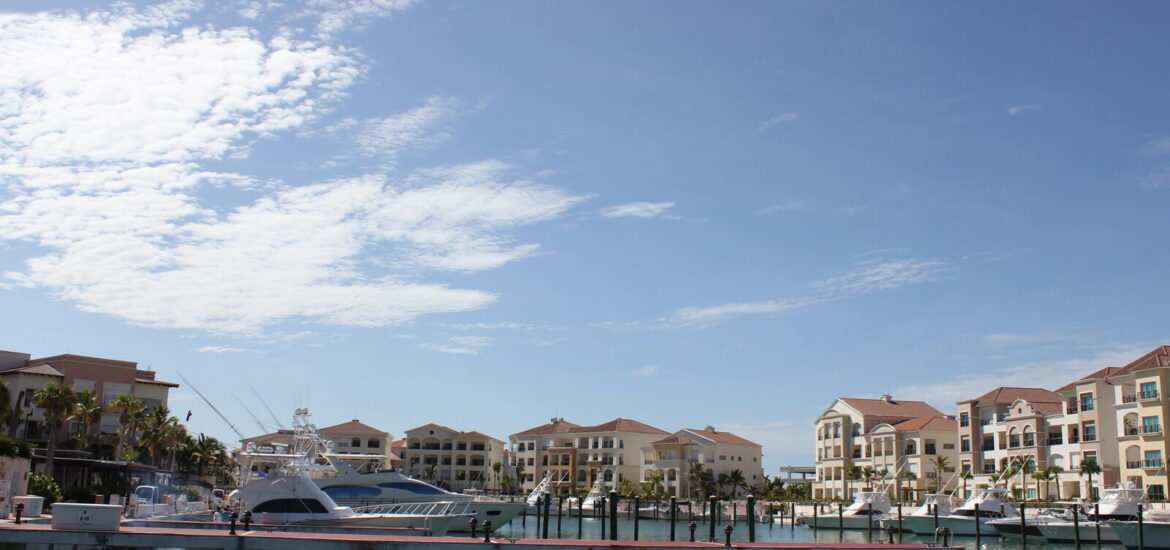
Photograph: town houses in Punta Cana by Flickr user uira, CC BY-SA 2.0, via Wikimedia Commons. Resized for web display; license unchanged. This photograph is not a CLAVE listing.