

 ES
ESProperty Taxes in the Dominican Republic in 2026: IPI and Transfer Costs Explained
 by Wiso
The price on a listing is not the amount it costs to own the property. In the Dominican Republic a buyer meets at least two different taxes, and they do not work the same way. One is charged when ownership is transferred. The other is an annual tax on a person’s real-estate holdings, and only above a threshold that DGII resets. Mixing them up is how people understate a purchase.
This article is for general information only and is not tax, legal, or financial advice. The figures below are the ones DGII has published for 2026. A specific file can differ. Have a Dominican tax adviser and a lawyer read the deed, the title, and any incentive the seller mentions.
Two taxes, two jobs
The transfer tax is a transaction tax. It is tied to an act that moves the property. The Impuesto al Patrimonio Inmobiliario, usually called IPI, is an annual tax on the stock of property a person or a trust already holds. Paying one does not pay the other. A home can generate a transfer bill at closing and an IPI bill in later years, or a transfer bill and no IPI, depending on the owner’s total holdings and on exemptions.
Neither tax is a substitute for the other costs of buying: notary and registration work, association fees, insurance, and whatever the building actually spends on electricity, water, and repairs. Those are not in the DGII rate.
The transfer tax, and why it is not always a flat 3 percent of the asking price
Law 288-04, as amended by Law 173-07 and as DGII restates it, applies a unified tax of 3 percent of the value of the property to real-estate transfers. The tax is payable within six months from the moment the transfer is perfected. After that window, surcharges and interest can apply. DGII’s help article CA4215, which the help community shows as updated, tells taxpayers to use the official calculator, to enter the commercial appraisal (the tasación comercial), and to treat the calculator’s result as an estimate that should be confirmed with the appraisal area of a DGII office. The listing price is not that appraisal.
DGII’s published service sheet also lists a separate RD$20 charge under Law 33-91. Use the statute, the service sheet, and the calculator together. Do not treat the brochure price as the tax base.
A buyer should not assume every closing produces exactly one 3 percent bill and nothing else.
- The calculator result is an estimate. CA4215 says to confirm it with DGII’s appraisal area.
- If the six-month period has already run, CA4215 points to surcharges and interest under article 252 of the Tax Code. The bill is then no longer the original 3 percent alone.
- Norma General 03-2024, issued on 28 November 2024, says that when the transfer procedure determines an income-tax obligation for capital gain, that gain is calculated under article 289 of the Tax Code. A transfer file can therefore include more than the 3 percent.
- The same norma says that, until the property is discharged from the seller’s name, IPI (or the asset tax, where it applies) remains demandable from the person in whose name the property is registered. Ask whether that tax is current before you rely on a clean closing.
- A project that advertises a tourism incentive has to show the act that grants it. DGII’s IPI page cites special laws, including Law 158-01, as examples of exemptions from IPI. That page is not, by itself, a statement that the transfer tax disappears.
The practical step is to ask DGII’s calculator and your adviser for the bill on this deed, and to ask whether any earlier act in the chain is still unpaid. The title check and the tax check are the same purchase, not two optional extras.
IPI in 2026: the threshold, the rate, and who it reaches
DGII describes IPI as an annual tax on the total taxable real-estate wealth registered to individuals and to trusts (fideicomisos). For 2026, resolution DDG-AR1-2026-00001 sets the exempt amount for individuals at RD$10,695,494. The current IPI page states the same figure and the rate: for individuals, 1 percent on the value above RD$10,695,494 of the taxable holdings. For trusts, 1 percent applies to the taxable value, and the RD$10,695,494 exemption does not apply.
The threshold is on the combined holdings, not on each apartment by itself. A person with two properties adds them before comparing them with RD$10,695,494. A single purchase under that number can still create IPI if the buyer already owns other taxable property in the country.
DGII says the tax is paid in two installments. The first is due by 11 March and the second by 11 September. The sworn IPI return is filed in the first 60 days of the year. Those dates are annual administrative dates. They are not the closing date of your purchase.
What the tax can reach, on DGII’s page, includes homes, urban lots, and property used for commercial, industrial, or professional activity.
Exemptions DGII actually lists
The same IPI page lists exemptions. They are conditions, not a slogan that “foreign buyers don’t pay.” As published there, exemptions include:
- The home, and the lot it stands on, of an owner older than 65, if that home is the owner’s only real-estate holding.
- A 50 percent treatment for pensioners and for people whose income is a foreign-source annuity, in the terms DGII states.
- Rural land, and agricultural improvements on rural land.
- Property exempt under special laws. DGII gives Law 158-01 as an example. Whether a given Punta Cana project qualifies is a document question, not a marketing question.
- Taxable property whose combined value is equal to or below RD$10,695,494.
Trusts are outside the individual threshold. If you buy through a fideicomiso, do not apply the RD$10,695,494 figure to yourself and stop. Ask counsel which person, or which trust, is the taxpayer.
The same January 2026 resolution adjusts two transfer-tax figures that are not a general discount on a Punta Cana purchase. Under Law 173-07, articles 7 (paragraph I) and 8, DGII lists an inflation-adjusted minimum exempt amount of RD$2,383,491 for real-estate transfers and for real-estate operations. Under Law 189-11, it sets RD$5,450,851.12 as the 2026 maximum sale price for low-cost housing developed by a housing trust, and as the transfer-tax amount exempted for a first-home buyer acquiring through that kind of trust. Those are specific regimes. Ask DGII and your adviser whether either one applies to your deed. Do not subtract them from a resort villa because the numbers appear in the same resolution as the IPI threshold.
What to add up before you sign
- Contract price, in the currency the contract actually uses.
- Transfer tax on the base your adviser and DGII calculate, plus the RD$20 charge, plus fees that are not the tax.
- Whether any earlier transfer in the chain is still open.
- IPI for 2026 on your combined holdings after the purchase, using 1 percent only on the excess over RD$10,695,494 if you are an individual and no exemption applies.
- Association or building costs, which are not IPI.
- Any claimed Law 158-01 or other incentive, with the official act attached.
Financing changes the cash you need at closing, not the existence of the tax. How to compare a loan, without treating one bank’s rate as the national rate, is covered in the 2026 financing note. The broader purchase sequence is in the guide for international buyers.
A calm way to use the numbers
RD$10,695,494 and 1 percent are real 2026 parameters. They tell you to measure the whole holding, not the listing. They do not tell you that a particular villa in La Altagracia is or is not a good buy. Put the tax line in the spreadsheet, then go back to price, title, and what the building costs to run.
Homes now offered on the east coast are on the property list. Tax questions about a specific file belong with your adviser, and CLAVE can help you gather the property side of that file through contact.
Sources and data
- DGII, resolution DDG-AR1-2026-00001, exempt IPI amount for individuals in 2026 of RD$10,695,494: resolution PDF.
- DGII, IPI page: 1 percent above that amount for individuals, 1 percent of taxable value for trusts, installments due 11 March and 11 September, return in the first 60 days, and the exemption list: Impuesto al Patrimonio Inmobiliario.
- Law 288-04 as amended by Law 173-07, unified 3 percent of the property value, payable within six months, as restated in DGII Norma General 03-2024 of 28 November 2024: Norma General 03-2024. Articles 12 and 13 of that norma cover IPI until discharge, and capital gain when the transfer procedure determines it.
- DGII help CA4215: calculator, commercial appraisal, estimate, and surcharges after six months: CA4215.
- DGII service sheet, including the RD$20 Law 33-91 charge: Transferencia inmobiliaria.
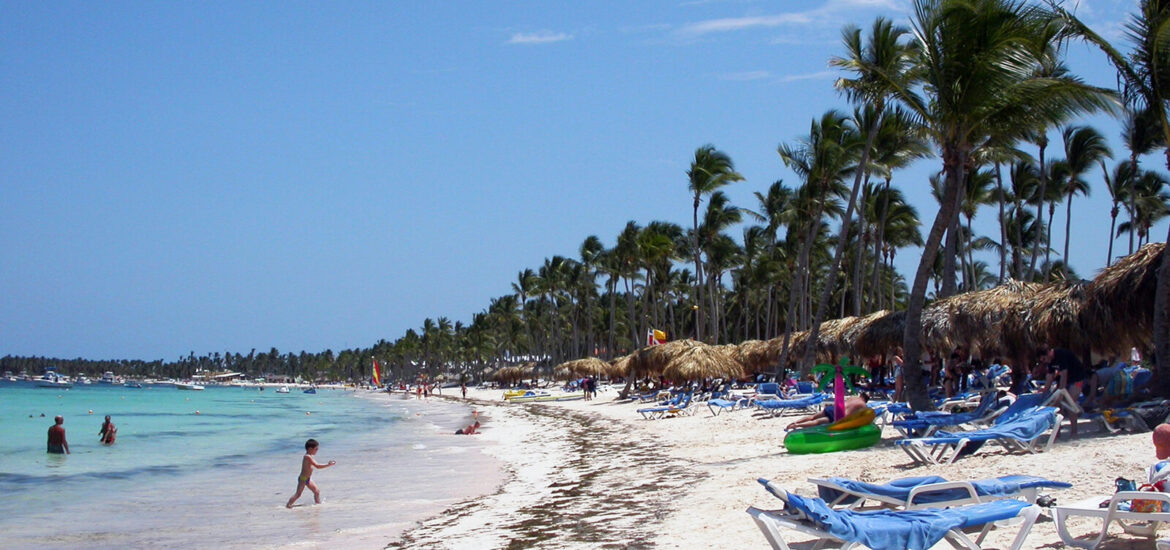
Photograph: Natura Park beach, Punta Cana, 2004, by DimiTalen, CC0, via Wikimedia Commons. Resized for web display.